THE VILLAGE VOICE, Tuesday, March 31st 2009 A Pleasing Secret History: Andrei Codrescu's Posthuman Dada Guide Tzara ain't so bizarra, says NPR essayist By Eli Epstein-Deutsch
Dada: An absurdist art movement declaring itself against rationality, tradition, and—above all—Dada. Catholic mystic Hugo Ball and poet/impresario Tristan Tzara launched it in Zurich as World War I blazed all around.
Posthuman: A sci-fi term that came of age in the mid-1980s through texts like Donna Haraway's Cyborg Manifesto. It's what we homo sapiens supposedly become when technological enhancements allow us to transcend our biology.
The Posthuman Dada Guide: A hard-edged, rapier-like volume, perfect for sliding into a back pocket of skinny hipster pants or stabbing into the complacent underbelly of bourgeois (or bourgeois-bohemian) society. Authored by NPR commentator and essayist Andrei Codrescu, it offers a headier-than-usual tour of the early-1900s avant-garde, sprinkled with sex appeal for the would-be MySpace-age revolutionary. Jacket blurbs from the likes of Josephine Baker and Aleister Crowley affirm the Guide's period credentials. Meanwhile, the whole thing is a kind of hypertext, composed of cross-referenced "database" entries—so you can't doubt its cyberpunk legitimacy.
My prayer is for the future of publishing: Let the earth’s resources be used resourcefully. Let the art be above the bottom line. Let books be more than just pictures and fonts (and let those be choosen with care). Let the design take full use of the form. Let the books we lug be the books we love.
Dear Jeff Bezos,
We’ve been fools worrying about the end of books, when there was no need to worry--it was already over. We fretted so much over the emperor’s new clothes, we didn’t notice he’s dead. The book died awhile ago; Print-On-Demand (POD) rolled the boulder over his grave. Now it’s up to the Kindle to resurrect.
An uptown, downtown poet or is it a downtown uptown poet. Then too, as Edwin Denby said of dancers "They should be pretty" as part of the environment, there is a look to these poems over the years that's consistent. Also could live in an elite basket but doesn't and like O'Hara who accepted life in the caldron around him, Amazo New York City, he finds the personal way to allude to and include the universal.
See a video interview about my new book is The Posthuman Dada Guide: Tzara and Lenin Play Chess, from Princeton University Press. . I don't know about you, but I think that the 21st century cannot do without Dada; this book is not another study of Dada! it is a practical guide to the Dada life. The Posthuman Dada Guide is an impractical handbook for practical living in our posthuman world—all by way of examining a 1916 chess game between Tristan Tzara, the daddy of Dada, and V. I. Lenin, the daddy of communism. This epic game at Zurich's Café de la Terrasse—a battle between radical visions of art and ideological revolution—lasted for a century and may still be going on, although communism appears dead and Dada stronger than ever. As the poet faces the future ideologue over the chessboard, neither realizes that they are playing for the world. Taking the match as metaphor for two poles of twentieth- and twenty-first-century thought, politics, and life, I’ve created my own Dadaesque guide to Dada—and to what it can teach us about surviving our ultraconnected present and future. Here dadaists Duchamp, Ball, and von Freytag-Loringhoven and communists Trotsky, Radek, and Zinoviev appear live in company with later incarnations, including William Burroughs, Allen Ginsberg, Gilles Deleuze, and Newt Gingrich. The Posthuman Dada Guide is arranged alphabetically for quick reference and (some) nostalgia for order, with entries such as "eros (women)," "internet(s)," and "war." Throughout, it is written in the belief "that posthumans lining the road to the future (which looks as if it exists, after all, even though Dada is against it) need the solace offered by the primal raw energy of Dada and its inhuman sources." Order now from Cottonwood Books This email address is being protected from spambots. You need JavaScript enabled to view it. or (225) 343-1266 and we will send you a signed book. The first fifty-one books will also come with a special Exquisite Corpse gift.
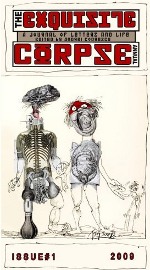
PRESS RELEASE: LEGENDARY LIT JOURNAL BACK IN PRINT!!! ADVANCE COPIES OF EXQUISITE CORPSE ANNUAL #1 ON SALE NOW! Ed in Chief Andrei Codrescu presents artwork by Ralph Steadman, Joel Lipman; poetry by Diane di Prima, Bill Berkson, Alice Notley, Mike Topp, Jim Gustafson, Ruxandra Cesereanu; prose by Jerome Rothenberg, Willie Smith, Aram Saroyan, Lance Olsen, Davis Schneiderman; and more more more! So get your historic freak on!
Send a check made out to "UCA" ($20 per issue) to Exquisite Corpse Annual/Department of Writing/University of Central Arkansas/Conway, AR 72035 or send PayPal payment to This email address is being protected from spambots. You need JavaScript enabled to view it.. For intl. orders please add $7.50 per issue for shipping. Lifetime subscriptions $100. Also available on Amazon.com .
Today (Feb. 9th) Jeff Bezos, CEO of Amazon, released details on the new Kindle --creatively dubbed Kindle 2, which means now the original Kindle will forever be referred to as Kindle 1.
Kindle is Amazon’s answer to a previously questionable e-book market, which began with big-fish hopes almost from the very start of the internet (of course, e-books weren’t the only hopefuls turning their bellies up in the web’s dark sea). Since the internet--really since the radio, but most recently with the internet--the death of print has seemed more and more inevitable. What actually happened was the aforementioned life-support-only, near-death of e-books and slow down of book sales. Or, to be more exact, people were just buying less books and hardly buying e-books at all.
With Kindle, everyone’s going to be eco-readers soon.
Not yr typical investigoetry by our Fugsly bard: mucho mas lyrical in span of three centuries from ye olde French & Choctaw trade to murky surge of "kill-swill down over 80% of the Polis....
And the bodies! Oh my God! like an image from a suicide bomb"
with plenty of that semi-Gonzo omni-bias, ie: "Low life of course defines high life and the perfect and imperfect alike are shat into the crypt by the partisans of Sky Slime!"
while shipping "these rotten Democrats to the morgue or disperse them like twisted seeds across the Red Beyond"
Oh yeah, this is epic bloody song of tragedy, history, desperation & all thy shameful weasle-tools, Amerigo sponging off the Mississippi's most dismissible genocide
SFox adds a sense of humor to suicides at Christmas along with uber contemplative vision-meter
like "Rockets' red glare burning its way... [to] visual cortex" mental derelicts converge with pond scum green herons, monkeys and meat to imprint upon the senses a quasi fuckyou on the dying process
très existential for ol' Skip noiry, chunky, songy & reflective
his most human(e) alchemy yet
and "if the tale be mad
does that concern the tongue ? "
The Selected Letters of Allen Ginsberg and Gary Snyder Bill Morgan, ed. Counterpoint www.counterpointpress.com
these indices are always best fer wordbytes on myriad flashes of flesh
Holy Testerotica, Batwoman! What do you get when you cross Bukowski Anais Nin, Diane Di Prima and America?
the answer = Neurotica an unapologetic bonefest for feminists farmers doctors and albatross inseminators (the whole dang self-destructo chuckwagon)
this is Gen-X bitchslap balling this is a true euphorimoir burning from the breast of anyone ever been burned but going for another Skronk
Memorials to Future Catastrophes CD by Davis Schneiderman and Don Meyer Jaded Ibis Productions Inc. jadedibisproductions.com
crazee crazee cacophony of broken spoken K-zanging techo-sympho-politico riffs strange with perpetual jesus epidemics synergizing sex w/ brando tom cruise pynchon blitzer one bold callabo mozaic of muse gone wild in studio and media on roids Man—this is digital Dope!
The Nancy Book by Joe Brainard, Los Angeles, Siglio Press, 2008 If... by Joe Brainard, Los Angeles, Siglio Press, 2008 www.sigliopress.com
Joe Brainard was both a great artist and a great writer, a rara avis, in the best of times. His epic I Remember, is one of the literary accomplishments of the late 20th century, a long poem in which every line begins with the words “I remember,” and then goes on to recall everything that Joe Brainard’s memory was able to recall, from his earliest childhood to the moment of writing. The swift and witty practice of memory in I Remember is an exercise in truth and accuracy, a manual of American culture, pop and not, and a psychoanalytical tour-de-force directed not just at specific and personal neuroses, but at the incurable and painfully amusing maladies of a whole society. Joe Brainard, like his New York School friends and contemporaries, Kenward Elmslie, John Ashbery, Bill Berkson, Ron Padgett, and Ted Berrigan among them, managed to ride with verve the zeitgeist of an age rich in creative stimulation and ready-made for revolution. Joe was a Pop artist, in the sense that his art, like his writing, blew out the frames of genre and the conventions of the medium, and partook with pleasure and energy from the demotic. “The Nancy Book” chronicles the adventures of the comic-book character Nancy in Joe’s own world, in collaboration with Bill Berkson, Ted Berrigan, Robert Creeley, Frank Lima, Frank O’Hara, Ron Padgett and James Schuyler. This beautifully produced edition comes also with essays by Ann Lauterbach and Ron Padgett. “If...” is a series of postcards presenting Nancy in a variety of “if” situations (see below). The reprinting of these extremely rare works by Joe Brainard is an event for at least two reasons: 1. “The Nancy Book” is a masterwork of collaboration from the age of collaboration between artists and writers, a practice of instantly communicable delight that occured only twice in the 20th century: the dada-surrealist age, 1915-1935, and the New York School, 1957-1973, and 2. while comix have become “acceptable” for both “high” art and commercial translation (into movies), they have never attained the freshness and impertinence of being recast for the first time with such vigurous insouciance. Joe Brainard was a genius who had the good luck of living at the right time and having genius friends. Snap up these books, people, you never know when another epoch of public misery and artistic glory will sweep us away. When it does, you’ll have guides.
Detail from IF... by Joe Brainard, 1974, (c) Estate of Joe Brainard
NOIR: A HISTORY OF MY BOOK REVIEWS: All around me, screaming silently à la E. Münch, the towers of unread books turned and turned toward me, a tiny man of flesh with no time on his hands or anywhere else on his body... Our alphabetical choices in literature, with awed and/or sardonic asides. Note: August 1, 2009. It was the end of May 2009 when we (I mean me, Andrei) put my two hands around my neck, squeezed hard and cried, I can't, I can't! This really happened when I realized that in the boxes of new books being shlepped 800 miles (again!) to a new abode, were literary gems that would never be read in their entirety, let alone reviewed. Since merely cracking them open and gleaning oracular answers to unasked questions is not this reviewer's style (others twitter even the dead, me no even speak if the flesh crit no there!) I decided to abandon reviewing. So by the wayside fell marvels by the Martins, Richard and Chris, Ioana Nicolae, Dan Sociu, Lucia Cherciu, B.Z. Niditch, Mike Topp, and many, many others, gleaned, briefly loved, and abandoned for lack of time and weariness. This may be temporary, and this note no more than the cry of the overbooked, but it's not deliberate neglect, I promise. Codrescu
On the other hand, advertising, unlike literature, never dies, it twitches unto eternity, see below:
Various reviewers on books that exhibit an independence of spirit. Each testifies to the range of fine writing being written and published in this imperiled day.