
Update Lucy In the Sky With Darrell: Actualism Part 4
| Lucy In the Sky With Darrell |
Part 4 A History of Actualism In Iowa City The Muse's Mailbag 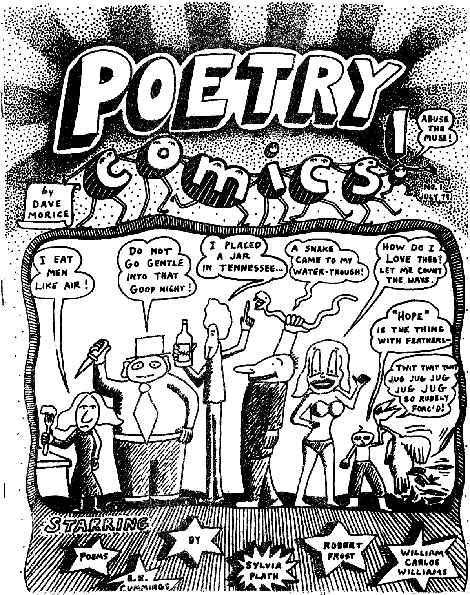 In the late 1970s I put out Poetry Comics, a comic book that presented poems in cartoon form. With issue number 4, the magazine included a letters-to-the-editor column called “The Muse’s Mailbag.” The column was another form of Actualist communication. It chronicled the readers’ responses to cartoon renditions of poems, and it placed the high art of poetry on the same level as the low art of cartoonery. Poetry Comics ended in 1981. Simon & Schuster had asked to publish an anthology of the cartoonized poems. Eventually, three publishers issued three anthologies. They are available through bookstores on the web. Poetry Comics: A Cartooniverse of Poems (Simon & Schuster, 1980)Recently, I decided to publish the magazine again. Poetry Comics #18 will debut on Andrei Codrescu’s EXQUISITE CORPSE website. 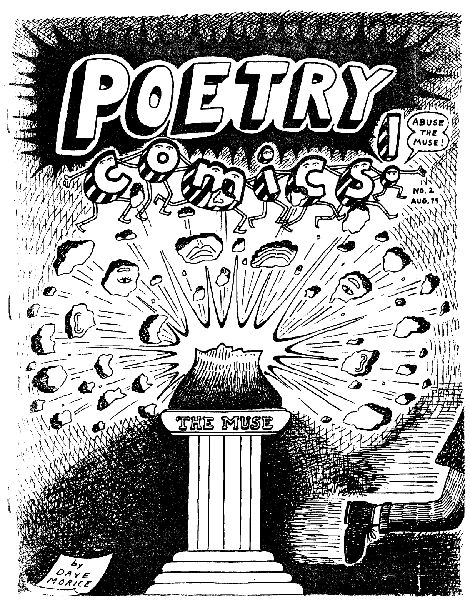 Weinstein: Are Poetry Comics Too Graphic? Jeff Weinstein The Village Voice New York, NY Jul. 29-Aug. 4, 1981 Poetry in Motion--In 1978 someone told Dave Morice that good poems would paint pictures in your mind. A lightbulb went on over the poet’s head. Why not Poetry Comics? Unless you write poems, the chances that you have read any contemporary poetry within the last year, or even the last 10 years, are slim. This is not criticism of the average reader, or of the average poet; it’s just the way of the poetry world. You may have nibbled at a sonnet with a famous byline in The New Yorker, or tried to swallow one of the well-meant meter- laden exercises in the back pages of The Nation, because this is all that’s generally available. But do you remember the poem? Do you talk about it? Do you want to read more? New poetry is mostly for poets only. Poets publish and distribute their own and other poets’ work in hundreds of small- press books and magazines. Poets read these poems (at least they always read themselves), argue about them, make a living by teaching them. Poets attend each others’ readings, praise and backbite, as- sort themselves into schools of differing influences and direction. The poetry world in this country is a tight little island, even more circumscribed than the art world or theater world, which at least acknowledge outside interest and support. Internecine poetry-world struggles may seem lively to an insider, but from outside, it’s a bit like watching people eat their own vomit. On the other hand, if poets don’t take care of themselves, who will? Certainly not major publishers, who aren’t disposed to print literature for which screen rights can’t be sold. A university press might, if the poet teaches at the same university, and promises not to feel too bad if the work is remaindered in three months because no one paid $12.95 for 87 unpromoted pages in cloth. Government small-press funding, an important source for poets and writers, is slowly going the way of all funding: to Grant’s tomb. Present exceptions to poets-only poems usually spring from the schools of poetry that try to speak to specific-audience groups: feminist, gay and lesbian, black, Hispanic, and Native American. Not all this work is wonderful, or even what the poet-poets call competent--think of a cat- egory where that isn’t true--and its au- diences are insular by definition; but it is being read by nonpoets. Although one would hope that some poet-poets would notice this, specific-interest poetry is not taken seriously by “professional poets” be- cause it breaks their rules: it supposedly lacks awareness of formal English- language tradition, it flaunts its historical content, and untrained people can read it, want to read it. Content and popularity are anathema to most of the poets-only poetry world; they connote a lack of seriousness. The poetry world distrusts popularity so much that it has sometimes disowned its own stars. But lately, the poetry world has not produced any stars. Nor is there a public democracy of exciting poets. We can only hope for Emily Dickinsons. Poetry, at the moment, is quiet. It may be that this reti- cence, this apparent unconcern with the world, is a failure not only of the poetry support system or of a postliterate, image- oriented audience, but of contemporary poetry itself. One of the tactics of modern- ism, of contemporary art of any kind, is to find its audience, to invent it if need be, or at least to try. * If I wasn’t on the outskirts of the poetry world I would never have received copies of Dave Morice’s Poetry Comics in the mail. At first I didn’t know what they were, couldn’t place them, which is a good sign. As they piled up in the bathroom, I began to see first how amusing they are, and then how smart. It’s one thing to illustrate, com- ic-book style, Coleridge’s “Rime of the An- cient Mariner” (issue number 12), a classic story that lends itself to narrative illustra- tion. Anyone who used Classics Illustrated comics to slog through Adam Bede in high school knows the predecessor here. It’s something else, though, to break “The Red Wheelbarrow” by William Carlos Williams (“so much depends / upon / a red wheel / barrow / glazed with rain / water / beside the white / chickens”) into narrative frames, as Morice does on the first page of the first issue, or to storify excerpts from Robert Browning’s “Fra Lippo Lippi” (everybody’s favorite), or, most tellingly, to request submissions from poetry-world poets to be comicized. This is not a Joe Brainard-like reciprocal col- laboration of a visual artist and poets. Although there is a tradition of inspiration in English poetry, either by religion, the secular muses, or the Romantic spirit of nature and dream, Morice’s inspiration is poetry itself. Poetry makes him want to draw comics. He is also inspired by the poets-only poetry world. Of course, Dave Morice, 34, is a poet. He has been writing poems since he was six. Once a student at the University of Iowa’s Creative Writing Program--Iowa City is the geographic center of the poetry world--Morice, sometimes known as Dr. Alphabet, publicly spray-painted the world’s longest poem, connecting New Jersey and Pennsylvania, across the New Hope-Lambertville Bridge. He invented “Joyce Holland,” a minimalist poet (her one-word poems, Matchbook, are stapled inside matchbooks) and performance artist who had no small effect on the poetry world; for three years Morice hired an actress to concretize her at readings. Morice also single-handedly created a now-famous school of poetry--famous to poets, anyway--called Cutism. His Cutist Anthology includes poems by Sally Lunchkins, Tommy Triped and others. “Have a nice day” artwork by Roberta Periwinkleshoe, and the requisite de- fensive polemic by Samuel F. Romular. Morice’s send-ups attest to his connection to a school of poetry that began in Iowa City (a real school, I think) called Ac- tualism. “Actualism does to things what light does to them,” says Darrell Gray in the Actualist Manifesto. “Cute, Cuter, Cutist,” says Morice, in the lost Cutist Manifesto. In 1978 someone told Morice that “good poems would paint pictures in your mind.” Morice wondered how “Prufrock” and Syl- via Plath’s “Daddy” would look as comics, so he drew them, publishing “Daddy” the next year in Poetry Comics No. 1, which he mailed to poets around the country. “Nev- er liked Sylvia Plath before you,” wrote Harley Lond, editor of San Francisco’s small-press Intermedia magazine. Poet- praise came rolling in: “Absolutely brilliant…” (Bill Zavatsky), “I love ‘em & so does my eight year old” (Joel Op- enheimer), “Terrific” (Maureen Owen), “… break through stony accretions!” (Anne Waldman), “… best buy in the universe” (Robert Creeley), etc., along with offers to use their work. Since poets snapped at the bait, Morice published their hermatic letters, and any others he received, in the Muse’s Mailbag, now a regular feature of the magazine. Poetry Comics began to illustrate the boundaries of the poetry world; poets love to be pub- lished in any form. The comics, however, are works in themselves. Literary tradition sits heavily on poets, and avant-garde poets since Apollinaire have tried to throw it off by attempting to “demystify” both their own work and poetry in general. Morice de- mystifies by juxtaposing familiar poems with various--and variously successful-- borrowed and original cartoon styles, sometimes to funny and sometimes to touching effect. But he also creates a story where little or none was apparent before by heightening the narrative affinity of language, an affinity more than one school of present poets absolutely denies. Nar- rativeness doesn’t harm poetry; even his attempt to frame, for example, the non- word syllables of John Cage into a nar- rative progression still acknowledges the randomness, the integrity, of the original. Since narrative has had a bad rep among modern poets, not everyone likes Morice’s supposed playing around. Denise Levertov mailed Morice her reservations, which he published: “… The thing is, as with parodies, a humorous angle on a non-hu- morous work of art may have the un- fortunate effect of spoiling the original-- i.e., one is liable to always have the recol- lection of the jokey version looming up and obstructing any further receptivity to some beautiful poem or painting.” It’s a weak poem that can’t hold its own, and Levertov doesn’t see how the comics are sometimes homages to the original, some- times creative readings, and always work in themselves. The “beautiful object” the- ory of poetry has kept a lot of people at arm’s length from some great work. Morice’s comics do more than defuse cant; they help to revivify poetry. Comic books are worth attention too, and so didact Morice, who teaches poetry to children and senior citizens and is adept at engaging them with tricks of the poetry teacher’s trade., demystifies once again by treating adult poet-poets to games, puzzles, an elaborate poetry crossword (first prize was $20 and 20 comic books, and a poetry anthology), an Ana- gramarama (Walt Whitman -- Law? Haw! I’m TNT), and Poetrivia (“In 1858 , Emily Dickinson served as judge in the Bread Division of the Cattle Show in Amherst”). Last year Morice began to send PC out of the poetry world, to a judiciously selected group of “famous people” who are not, to my knowledge, poets, and printed some of the interlopers’ responses in the Muse’s Mailbag. Art Linkletter, Liza Minnelli, Virgil Partch, Elizabeth Taylor Warner, S. I. Hayakawa, Vincent Price, Clayton Moore (the Lone Ranger), Pearl Bailey, John Kenneth Galbraith, or their secretar- ies, to name a few, acknowledged receipt. Many, like Ruth Gordon, were pleased: “Your comics have a lot of style. A lot of drive. And nice to hear from Iowa City. I played a one night stand there in late 1916 or 1917 early on. Fair and Warmer. My second year of acting and I was a leading lady.” But others were less accessible. “Since this type of humor is not the kind that Lily finds amusing I am returning it to you without having presented it to her.-- Julie Harding, Secretary/Assistant to Lily Tomlin.” Morice sent these copies out of curiosity, but also as a work of mail art. (Mail art--using the post office to dis- tribute work made expressly to be mailed) has been utilized by artists like Eleanor Antin to comment on, and solve by in- corporating into their art, the problems out of towners face in a New York cen- tered art and publishing world. With the right mailing list…) If only distribution were poetry’s major problem. One can’t expect a public to hang on every word of even the best modern work the way a great proportion of the English readership tracked Childe Harold’s Pilgrimage as if it were news. (A “great proportion” of England’s readers in 1812 was, however, a tiny fraction of its population.) Of course, popularity alone cannot be any measure of merit; the new may be difficult, and, subject to the motives and skills of the publishing in- dustry, we can’t assume that the good will out in any case. But how has pleasure been drummed out of the poetry we have, from a form that so much depends upon a reader’s active delight in language and surprise? Once a student of English, and a teacher, I suspect that some of the pleasure in creative, polysemous reading is taught out of poetry, for those who are exposed to it at all. Dave Morice’s serious success in Poetry Comics, “slight stuff” as one an- noyed writer called them, is not only that he tweaks the nose of the poetry world, but that he dares to reactivate at least one of poetry’s pleasure principles, the freedom that “I can read it as I please.” A little pleasure will demand more. Poets and uninitiates alike can sample a copy for $2--a lifetime subscription is $50--by writing to Morice at Box 585, Iowa City 52244. It is unfortunate that, unless something changes, the inside of that post-office box may be as close as the two groups will get. 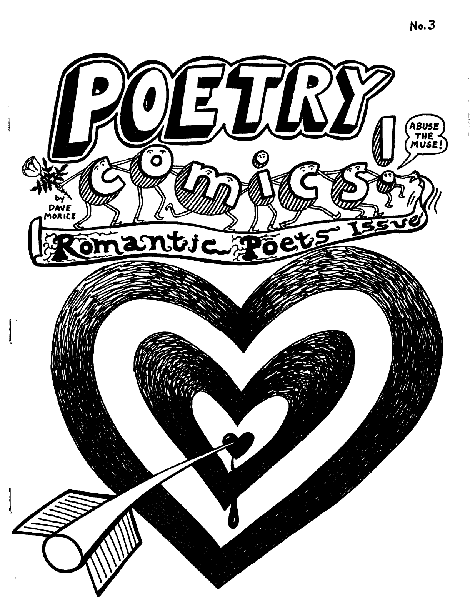 Andrei Codrescu City Paper Baltimore, OH Jan.16-20, 1981 POETRY COMIX, EDITED BY DAVE MORICE, BOX 585, IOWA City, Iowa 52244, has been rapidly “cartoonizing” the world’s great poetry. All the cartoons are by the editor while the words in the balloons of his incredible landscapes and characters and landscape-characters are by Emily Dickinson, Shakespeare, Hart Crane, Walt Whitman, Wallace Stevens, William Carlos Williams, John Cage, Darrell Gray, Pat Nolan, Clark Coolidge and others. Morice, or “Dr. Alphabet” as he is fondly known, is a fine poet in his own right whose sense of what poetry can do has gone beyond the page on several occasions. He has invented Joyce Holland, a minimalist poet, who made quite a name for herself both for her performances (an actress was hired for them) and for her magazine of one-word poems, Matchbook, which was stapled inside matchbooks donated by local businesses. She would have gone on to a great career if Morice hadn’t abruptly blown her cover after three years. In two separate bids for entries into the Guiness Book of World Records, Morice wrote “the most poems at one sitting,” a 24-hour effort which produced one thousand poems in an Iowa Bookstore, and “the world’s longest haiku,” a haiku with a mile-long middle line. People dressed in “poetry clothes” appeared with Morice on several TV shows. A senior citizen’s poetry class led by Morice made a “poetry chair,” completely covered with words, as well as a very fine poetry magazine. Morice’s playfulness is, in varying degrees, characteristic of the small group of poets from Iowa calling themselves “Actualists.” “Actualism,” says David Hilton, who is in The Actualist Anthology (The Spirit that Moves Us Press, 1977), “is a perception of the world without preconceptions.” Darrell Gray, who baptized the movement, explains in his Actualist Manifesto: “Actualism does to things what light does to them.” Since its inception in the early 1970s, Actualism has taken surprising flight. Some of the magazines connected with it are among the finest poetry publications of the past decade: Toothpaste (edited by Allan Kornblum), Suction (Darrell Gray), Search for Tomorrow (GeorgeMattingly, who later founded Blue Wind Press), Gum (Dave Morice), Matchbook (Joyce Holland)… The contributors have included well known contemporary poets alongside the original Iowa group. Other magazines of the time took on an “actualist” tinge if only because the spirit was contagious. I can think of Blue Suede Shoes (Keith Abbott, in California), The End (Pat Nolan, in Californiaj), Strange Faeces (Opal L. Nations, England). Actualist sympathies were surrealist, New York School, cannabis, beat and Midwestern, and still are. Several “Actualist Conventions” were held in Iowa City, Berkeley and San Francisco, wonderful events open to performance art, video and strange musical happenings. It all started as a “put-on esthetic movement” and went on to become an enduring sensibility. Poetry Comix goes a long way toward demystifying the poetic act without taking away the greatness. Morice’s readings are accurate, respectful, awed at times, and always sympathetic. Even when he gives a somewhat “lateral” reading, as in the case of “Xanadu” where Kubla Khan’s “pleasure dome” is a huge skyscraper named “Samuel Taylor Coleridge” in the middle of a futuristic, solar city, the perception is right on. Poets have responded enthusiastically to the idea, as many of the letters reprinted in the magazine attest. A few, Denise Levertov among them, have objected to what they see as excess frivolity, but they miss the point. If anyone is to go near poetry out of any sense other than duty, we need more, not less, humor. “Abuse the Muse” and “Amuse the Muse.” It does both, with great style. --Andrei Codrescu By Poetry Comics No. 4 (PC-4), I’d been receiving lots of mail. With that issue, I started a letters column. The title was a take-off of the Metropolis Mailbag appearing in Superman Comics. The letters column enabled readers to play an active role in Poetry Comics, to take part in it, to collaborate in it--and collaboration is one of the seven pillars of Actualism. 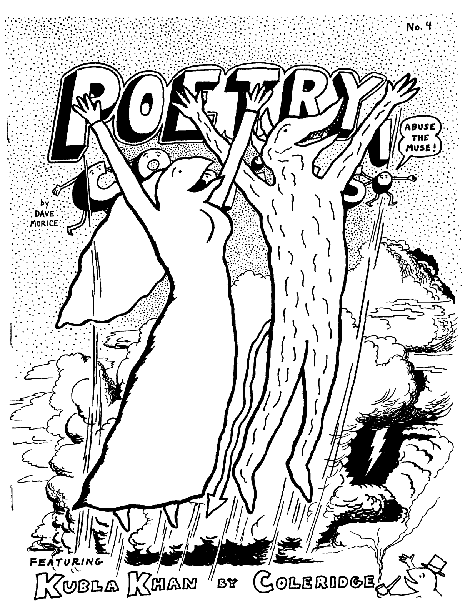 THE MUSE’S MAILBAG (PC-4, Dec 79) The comics sabotage the rhetorical qualities of the poems, ballooned into portentious fragility, much needed in some cases. Why not go for the real rhetoricians, John “The Aesthete” Ashbery, Robert “Skunk Hour” Lowell? Substantial works come off worst in this form. Romantics are obvious targets, Elizabethans. Why not de-fuse the cant of contemporary works? Bly, for example. Cheers. Change the world, --David Gitin Thanks so much for the new POETRY COMICS. I and my wife have been enjoying them tremen- dously. They are absolutely brilliant, real “translations” from the verbal to the visual. Too bad Harcourt, Brace doesn’t get smart and commission you to comicize T.S. Eliot’s complete works. I’d like to do a writeup on the series for the spring issue of SUN. Should I stay away from mentioning or reproducing non-public domain material, like the Pound and Eliot, etc.?--which might get us both sued? (I’m assuming you haven’t cleared rights to them with the publishers.) Anyhow, I’ll be back to you on this before long. Let’s hear from you! Keep up the beautiful work… --Bill Zavatsky, SUN And so I said to myself, “Micki, what better time to sit down and dash off a billet doux to Dave.” A friendly letter to let you know how much I enjoyed your rendering of a favorite poem “Ozymandias”; to express my sincere thanks to you for printing my letter; to tell you how clever and intellectually stimulating I found your contest. And to let you know, in a friendly way, that if I don’t win first prize you can kiss that check for $10,000 good-bye. Your friend, --Micki Gottesman, SHANTIH * * * A WORD FROM THE REVIEWERS “POETRY COMICS #2 offers neither poetry nor comedy.” (sent in an envelope addressed to “POETRY VOMIT”) --SAMISDAT #86, review 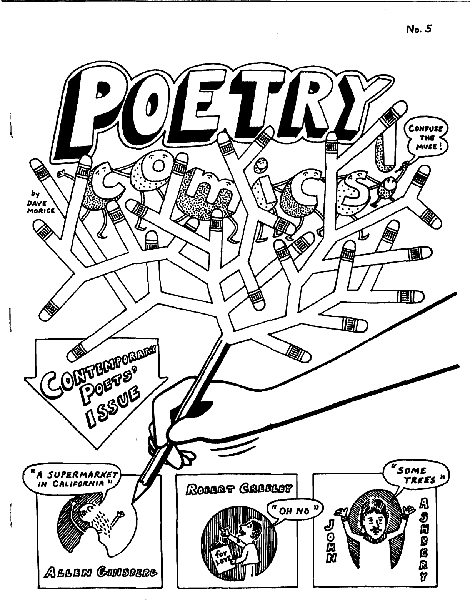 THE MUSE’S MAILBAG (PC-5, Jan 80) Your abuse-the-muse comix were greeted here with joy and enthusiasm as the proper aegis for the new decade and were as such trans- formed into coffee-house books (right there, on top of the TV where everyone puts the cup) and seen by all. Alice wonders if you accept contributions. If so, she’d love to get down with Homer. Not really, but she would like to know. Speaking of Homer, he’s teaching in the Classics Dept. at Johns Hopkins here. Several of him, that is. If you want a professor, produce a child & name him or her Homer. Then he can join us. --Andrei Codrescu Good to hear from you again. I enjoyed the Poetry Comics, a neat idea. How’s about doing experimental poems in abstract graphic-comic book illustration? What’s new, you say!, well I’ve gone over to Exprot (Macdonalds) Canadian Cigarette rolling tobacco from Dutch-Drum which is a little like rot-gut. Send a couple of comics to my buddy Ken Brown, he’ll love em. --Opal Louis Nations Anselm showed me the comics which are genius & I’d like to order for my Naropa students-- 10 of each? Please send & bill me… Always admired everything you’ve done all these years & wish you a happy 1980! Beautiful, still, discreet here in Sweet Briar. We’re about to drink some “Old Bourbon Hollow” & I read tonite. --Anne Waldman Thanks for sending those wonderful comix-- --Anselm Hollo Many thanks for Poetry Comics #3 & 4. I especially enjoyed I WANDERED LONELY AS A CLOUD & WHEN I HAVE FEARS, as did Shelley, my girl- friend. Bright rays of light over our other- wise potentially dismal vegetarian life. Storm clouds now “usurping” the sky. I am moving next week. Teaching high school still, & re- cuperating from 4 days in the hospital with pneumonia--a horrible ailment that attacks the lungs and appetite. Your comics were a source of great inspiration (as opposed to expiration). Keep them coming! Maybe do D.Dickinson’s “I Heard a Fly Buzz When I Died” or Weldon Keyes’ “The Crack”?? --Darrell Gray God -- it’s been so long since we met & we just got to talk so little & there were some Other people there -- it was all so wonderful -- & we xchanged periodicals & literary whatnots across the burly brown spring continent. Feel real dumb, believe you me, for not writing previously. Rereading Speakeasy #3 – terrific -- I’m teaching elders now too -- – my hand hurts -- heavy -- surprise… Bill me for a subscription, Comix too. They’re NUTS! --Jeff Wright, Hard Press Everyone everywhere should be forced against their wills to do poetry comix. --Tom Ahernj, Diana’s Bi-Monthly * * * A WORD FROM THE REVIEWERS More |